Booking choice: The Tokyo Toilet Tour for Perfect Days, from $100 per person. Check dates Tour details
Most visitors meet their first Japanese bidet seat at the airport and stare at the panel for a while. That is normal. Wikipedia's article on toilets in Japan notes that these panels often explain themselves only in Japanese, and that the flush is sometimes written in kanji alone. Once you know six symbols, it all clicks.
This guide covers the buttons, where toilet paper goes, the slippers you may find at the door, squat toilets, the flush and the sound device, and how to ask for the toilet in Japanese. The last section is about the Tokyo Toilet in Shibuya: 17 public toilets by 16 creators, every one of them free and fitted with a Washlet.
The quick answer
Put used toilet paper in the bowl and everything else in the small bin. Sit as usual on a bidet seat, press the rear or front wash, then stop before you stand. If slippers wait at the door, wear them inside and leave them there. On a squat toilet, face the raised hood. Carry a handkerchief, because many toilets have no towels.
What are the etiquette rules for using a toilet in Japan?
Paper goes in the bowl, everything else in the bin, and you leave the toilet as clean as you found it. Add slippers and a quiet voice and you have the whole code.
The rules are short. GO TOKYO, the official Tokyo travel site, puts them in three lines: put toilet paper in the toilet, not in the trash can; keep the toilet clean for the people who use it after you; and leave it the way you would wish to find it. That last line is the spirit behind all the others.
- Flush only toilet paper. Sanitary products, wet wipes and pocket tissues go in the small bin in the stall.
- Switch to toilet slippers if a pair is waiting at the door, and leave them there when you go.
- Read the panel before you press. The flush, the wash and the call button can sit side by side.
- Wipe the seat and check the floor before you leave. Nobody will ask you to, which is the point.
- Wash your hands and dry them on your own handkerchief or under the air dryer.
The Tokyo Toilet team says the same thing in its own words. Its maintenance page notes that people find it hard to spoil something that has been carefully cleaned, and ends with a plain request: think about the next person who will use the facility after you.
See the manners in action: the Perfect Days route from Hachiko visits several designer toilets and a Shinto shrine with a local guide.
Check dates for the Tokyo Toilet Tour for Perfect DaysHow do you use a Japanese Washlet?
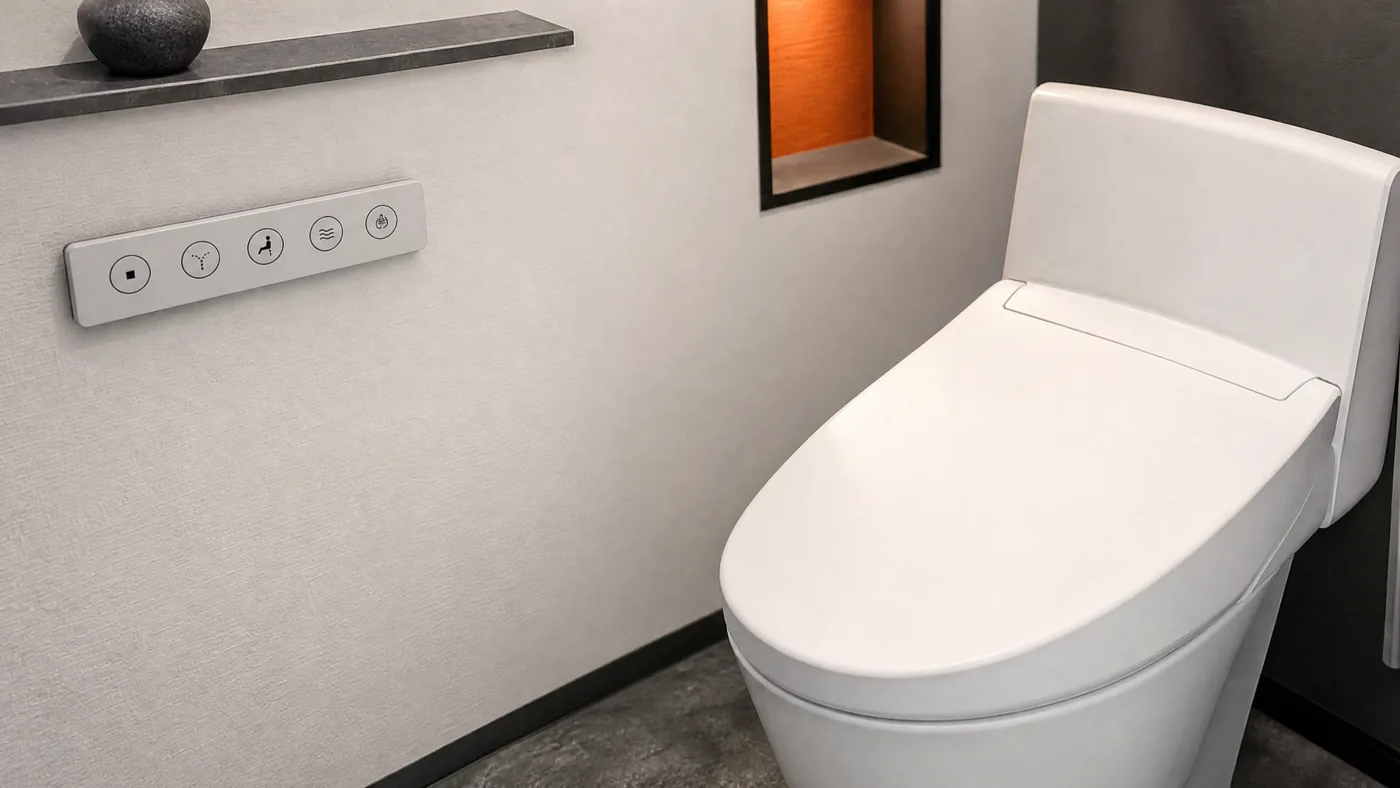
Sit down as on any toilet, press the rear or front wash, adjust if you like, then press stop. Many seats stop on their own when you stand.
Washlet is a TOTO brand name. Wikipedia notes that Japanese people use the word for bidet seats of every make, and that 81% of Japanese households had one in March 2016. The basic set is a rear wash, a front wash, a heated seat and a deodorizer. The nozzle comes out from under the seat, never touches you and cleans itself before and after use.
In January 2017 the Japan Sanitary Equipment Industry Association, whose members include TOTO and Panasonic, agreed on a shared set of eight pictograms for these panels, so new models look alike. Older panels still vary. These are the labels you are most likely to meet:
| Label you may see | Say it | What it does |
|---|---|---|
| おしり, or a seated figure with a spray | oshiri | Rear wash |
| ビデ, or a figure with a spray from the front | bide | Front wash (bidet) |
| 止 on a square button | tomeru | Stop the wash |
| 乾燥, or a fan of warm air | kanso | Warm-air dryer, on some seats |
| 水勢 with plus and minus | suisei | Water pressure up or down |
| 大 and 小 on a lever or button | dai, sho | Big or small flush |
| 音姫, or a musical note | otohime | A flushing sound that masks noise |
| 呼出 or 緊急, often on a separate red button | yobidashi, kinkyu | Calls for help: it does not flush |
Three habits save you a surprise. Sit down before you press anything, because the wash is linked to a sensor in the seat and on most new models works only while someone sits on it. Start on low pressure. And look for the flush last: on heated seats it is often a button right next to the seat or on the wall panel.
Wikipedia adds that the wash can replace paper completely, but many people use both, some washing first and some wiping first, each to their own preference. Paper is always there for the last step.
A morning of designer toilets across Shibuya with a guide who explains each one, plus a Shinto shrine and the stories of Perfect Days.
Explore the Tokyo Toilet Tour for Perfect Days Tour detailsDo you throw toilet paper in the toilet in Japan?
Yes. Used toilet paper always goes in the bowl and is flushed. Pocket tissues, sanitary products and wipes go in the bin.
Visitors from places where paper goes in a basket often hesitate here. Do not. GOOD LUCK TRIP, the travel site of the Arukikata guidebook company, writes that flushing it is the norm in Japan, and tsunagu Japan says used paper is always flushed together with your waste.
The catch is the pocket tissue. Tissues handed out on the street or bought in packs are made for noses, not for pipes, and GOOD LUCK TRIP warns they may not dissolve and could clog the toilet. Use them, then put them in the bin. The cardboard core of a finished roll can go in the bin too.
Should you bring toilet paper to Japan?
You do not need a roll. japan-guide.com says toilet paper is almost always provided in public washrooms, and GOOD LUCK TRIP calls public toilets well stocked. Two small things are worth a pocket:
- A handkerchief or small towel. Wikipedia notes that many public toilets have no soap or towels, and that many people carry a handkerchief for that reason.
- A pack of tissues for the rare empty holder, used and then binned as above.
The full list for your bag is in our Japan packing post.
What are toilet slippers and when do you wear them?
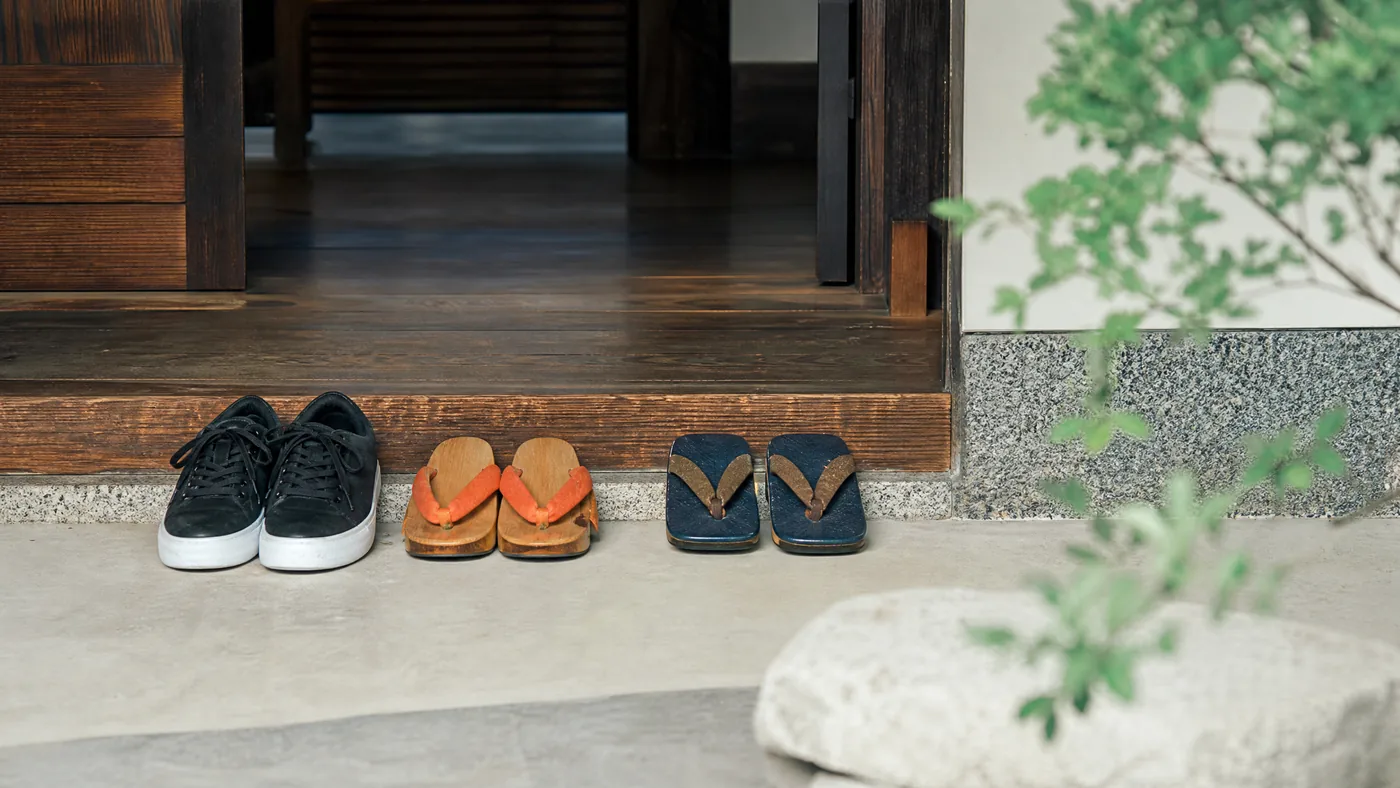
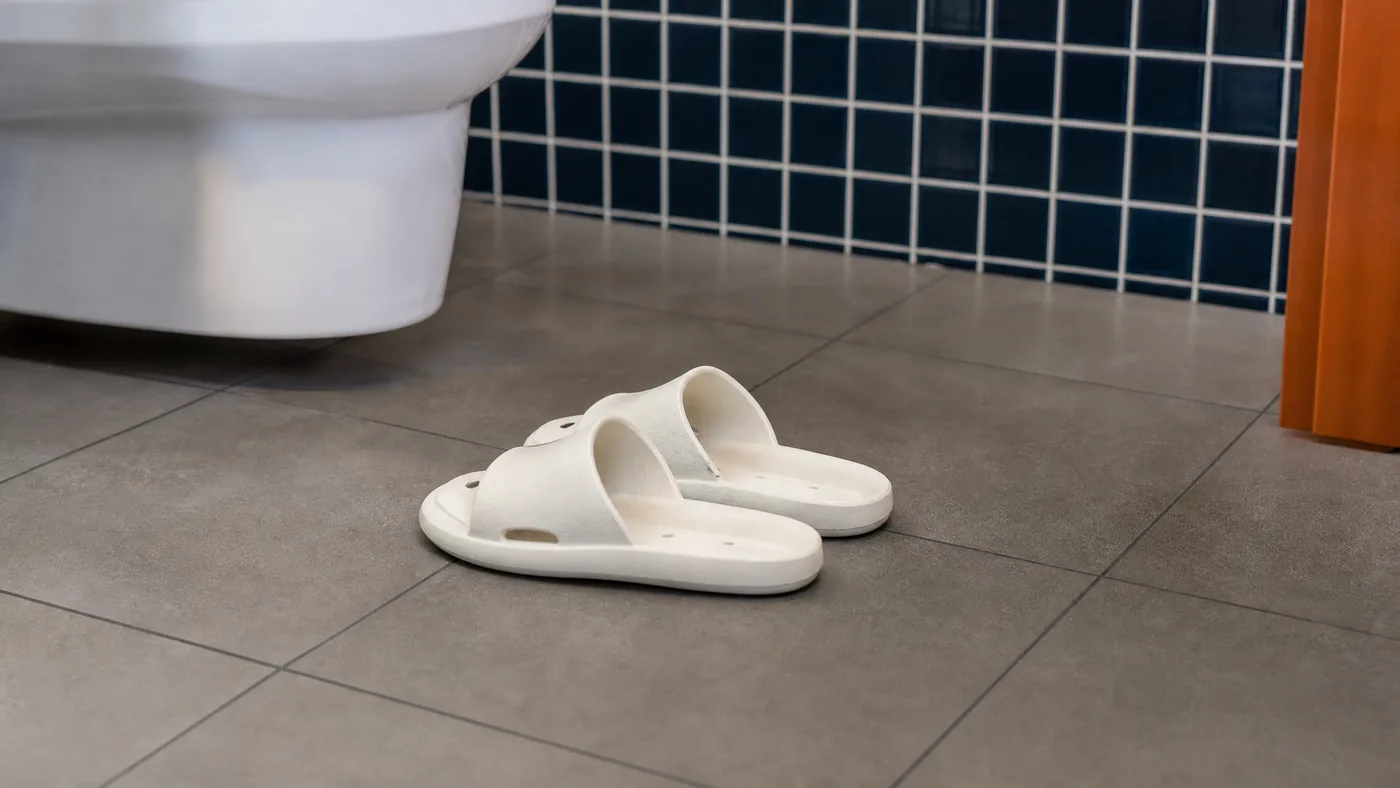
In homes, inns and some restaurants and public toilets, a pair of slippers waits at the toilet door. Wear them inside the toilet only, and step back into your own when you leave.
Japanese homes keep clean and unclean areas apart. Outdoor shoes come off at the entrance, and the toilet counts as unclean even inside the house. Wikipedia explains that many homes and some public toilets keep toilet slippers in front of the door for use in the toilet only. A pair sitting outside also tells you the room is free.
The classic slip is walking back into the dining room still wearing them. Wikipedia lists it as a frequent mistake of visitors, and it is the one people remember. Leave the toilet slippers facing the door, so the next person can step straight in.
Where will you meet them? In a ryokan, a home, a temple lodging or a restaurant with tatami rooms. JNTO says some attractions, restaurants and traditional hotels will ask you to take off your shoes, so socks without holes are a quiet win. The public toilets of the Tokyo Toilet are walk-in buildings in parks and on streets, so you keep your shoes on there.
Prefer a small group? A private guide walks up to four of you from Shigeru Ban's glass toilet to Kengo Kuma's cedar toilet.
Check dates for the private Tokyo Toilet walking tourHow do you use a squat toilet in Japan?
Face the raised hood, lower your pants to your knees, and squat close to the front over the trough. On a raised model, stand on the platform first.
The squat toilet is the traditional Japanese style, called washiki. It looks like a small urinal set into the floor. GOOD LUCK TRIP explains that the raised dome, the kinkakushi or splash guard, is the front, and japan-guide.com says the same: face the front of the toilet.
- Stand over the trough, feet on either side, facing the hood.
- Pull your pants and underwear down to your knees, or lift your skirt. You do not need to take anything off.
- Squat close to the front, so everything lands in the trough.
- Paper goes in the trough. Flush with the lever, button or pedal, often marked 大 and 小.
Holding your pants away from the floor with one hand helps, and so does emptying your back pockets first. Phones have been lost this way.
Where will you find them? Wikipedia notes that many train stations in the Tokyo area, older parks, temples and traditional restaurants still have squat toilets, often next to sitting ones. Western-style stalls are marked 洋式 (yoshiki), the words Western-style, or a pictogram, and accessible toilets are always Western style.
How do I flush the toilet in Japan, and what is the Sound Princess?
Look for a lever, a button or a sensor, usually with 大 for a big flush and 小 for a small one. The Sound Princess is a device that plays a flushing sound for privacy.
There are four kinds of flush and you will meet all of them in a week:
- A lever on the tank, turned one way for 大 (big) and the other for 小 (small).
- A button on the wall panel or beside the seat, common on heated seats.
- A hand sensor you wave at, or a seat that flushes when you stand up.
- A pedal on some squat toilets.
If nothing happens, wait a moment: some automatic flushes run after you step away. And leave the red or separate button alone. tsunagu Japan notes that buttons marked kinkyu (emergency) or yobidashi (call) call for help, and Wanderlust tells the story of a visitor who could not tell the call button from the flush and left without flushing at all.
The Sound Princess
Otohime, the Sound Princess, is a TOTO brand name for a device that plays the sound of flushing water. Wikipedia explains that many women once flushed again and again to cover the sounds of the toilet, wasting water, and that the device was introduced to stop it. It is now routine in new public women's rooms, as a wall box or a button on the bidet panel, and is estimated to save up to 20 liters of water per use. Press it, or wave at its sensor, and it stops on its own.
The film's toilets around Yoyogi, then Harajuku and Sugamo: a three-hour walk with a storyteller.
Check dates for the Perfect Days movie walkHow do you ask for a toilet in Japan?
Say "Toire wa doko desu ka?" (Where is the toilet?). Start with "Sumimasen" (excuse me) and people will point the way.
Toire, from the English word toilet, is the everyday word for both the toilet and the room. LIVE JAPAN, the travel guide run with Tokyo's rail companies, gives the full question as Toire wa doko desu ka. Open with Sumimasen to get someone's attention, and finish with Arigato gozaimasu.
Signs use other words too. Wikipedia lists otearai, literally hand-washing, as the polite word, and keshoshitsu, powder room, as the one you see in department stores. Benjo is the plain old word, still common in schools and public baths.
What do Japanese call toilet paper?
Toiretto pepa, written トイレットペーパー: the English words in Japanese sound. A pocket pack of tissues is tisshu. The wash seat is the Washlet, or onsui senjo benza (warm-water wash toilet seat), and the toilet bowl itself is benki.
In practice you rarely need to ask. Wikipedia notes that public toilets are in department stores, parks, most convenience stores and all but the most rural train stations. In a convenience store, a quick Sumimasen and a gesture toward the back is polite before you use it.
What makes the Tokyo Toilet in Shibuya different to use?
The 17 toilets are free public toilets with wheelchair access and a Washlet at every one. The etiquette is the same; the buildings are not.
The official site of THE TOKYO TOILET says each location has wheelchair access, some have ostomate facilities, and all are equipped with a Washlet. Shibuya City manages them, and they are cleaned up to three times a day, with a monthly and a yearly deep clean. No ticket, no fee, no opening ceremony: you walk in.
A few of them ask something new of you:
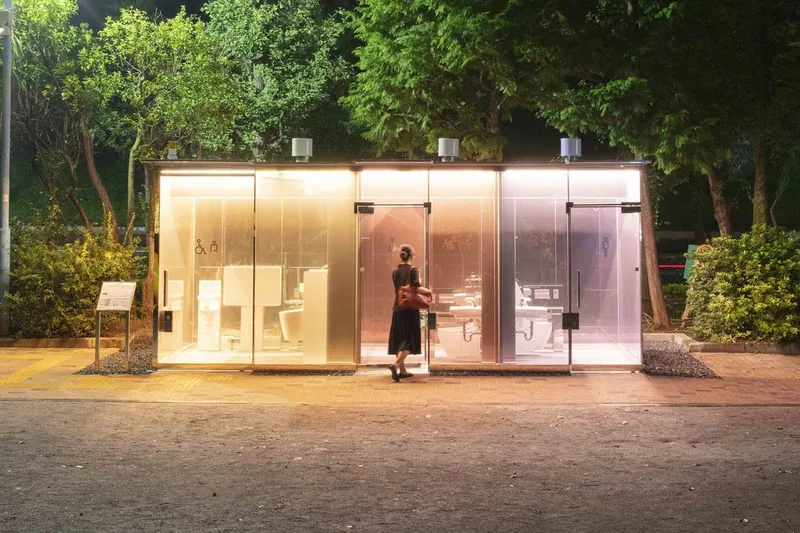
- Shigeru Ban's glass toilets in Haru-no-Ogawa Community Park and Yoyogi Fukamachi Mini Park are colored glass you can see through when empty. Lock the door and the walls turn opaque. Ban designed it so you can check the inside is clean and empty before you enter, which also makes them safe to use at night.
- Kazoo Sato's toilet in Nanago Dori Park is a contactless toilet: in its universal booth the commands work by voice, a system he calls Hi Toilet.
- Kashiwa Sato's pictograms, drawn to the JIS standard with softened corners, are used at every location, so the signs read the same across the ward.
Two manners matter more here than anywhere. These are working toilets in quiet neighborhoods, so keep your voice down and step aside for people who need them. And take photos of the outside: the stalls are for use. The project's maintenance team reports graffiti and damage at the busiest sites, Jingu-Dori Park and Ebisu East Park, so treat them as you would your own.
Where all 17 are, who designed each one and when it opened is in our guide to the Tokyo Toilet. To walk them on your own, use the self-guided walk.
Start at Hachiko and see the Perfect Days toilets on foot and at an easy jog, with a guide who knows the stories behind each design.
Explore the Tokyo Toilet Tour for Perfect Days Tour detailsFrequently asked questions
Are public toilets free in Tokyo?
Yes. Public toilets in parks, stations and most convenience stores cost nothing, and the 17 designer toilets of the Tokyo Toilet in Shibuya are free public toilets open to anyone.
Do Japanese people use a bidet or toilet paper?
Usually both. Wikipedia reports a bidet seat in 81% of Japanese households in March 2016, and notes that many people use the wash and paper together, in whichever order they prefer.
What does Japan use instead of toilet paper?
Nothing replaces it: the Washlet, a bidet seat with a warm-water wash, is used alongside toilet paper. Paper is provided in almost every public toilet and is flushed in the bowl.
Should I take toilet paper to Japan?
No. Public toilets almost always have paper. Bring a handkerchief, because many have no towels, and a pack of tissues for emergencies, which goes in the bin, not the bowl.
Ready to book
Choose your tour
Free cancellation up to 24 hours before on every option. Prices are from-prices in USD and move with the season.
The Tokyo Toilet Tour for Perfect Days
- Guided route through Shibuya, Harajuku, Yoyogi and Ebisu
- Designer public toilets from Perfect Days
- A Shinto shrine visit
Perfect Days Movie Walk: Yoyogi to Sugamo
- English- or Italian-speaking storyteller
- Designer toilets from the film
- Harajuku and Takeshita Street
Private Tokyo Toilet Walking Tour
- Private guide, no other groups
- Shigeru Ban's transparent toilet
- Yoyogi Hachimangu Shrine